Child Poverty in New York

What is Child Poverty?

The phrase “child poverty” refers to children living in poverty. These children can be living in low-income families, or in orphanages. Child poverty is something that plagues this nation with its wrath. 22% of children in the U.S. live in low-income families, most of which are under the age of 5. This has forced numerous parents to send their children to work at young ages, or leave them in the hands of family/government services.

How Does it Affect Children in New York?

Child poverty in the city differs based on borough and ethnicity. The average percentage of children in New York living in poverty was 25.2 as of a 2017 study. However, many borough’s have different statistics. For example, “the highest percentage of children living below the poverty level is in the Bronx, with nearly 40% of children under 18 (141,034) compared to 15.6% (72,328) in Queens“. Also, race and ethnicity differ as “families with black heads of household are in poverty almost twice as much as families with a white household head, with 17.3% and 9.3% living in poverty respectively“.

Help The Children.

Families in poverty need our help. The city has made public school lunches free for all, but there is much more to be done.

Spread awareness for children AND adults living in poverty using #end_poverty_ .

-K

Sources:

https://www.cccnewyork.org/blog/new-census-data-reveal-30-percent-of-nyc-children-living-in-poverty-are-under-age-5/

https://www1.nyc.gov/assets/opportunity/pdf/NYCPov-Brochure-2018-Digital.pdf

Poverty? Easy To Remove?

Many people believe that an end to poverty is easy to achieve. However, it is certainly not that easy to put an end to poverty.


1. Pay out of current government moneys
There are many benefits to the economy:
-more economic activity, so more taxes
-less need for benefits, so less government costs
-reduced minimum wage, so more employment, so again more taxes
-less crimes of desperation
-more intelligent behaviour from the poor (yes)
-disincentive to immigration, as would apply to citizens only; there is also less incentive for people to move from other countries with a similar policy
-reduced inequality means reduced discontent with governments
-of course, you would net off against current tax and benefit schedules so that most people were not directly affected and continued to be paid the same as previously
-etc.

https://wordpress.com/read/blogs/106106236/posts/11898

Many, if not all, of these ideas are flawed. For example, if more taxes are put in place, then many low income families will be subject to poverty, destroying it’s purpose. This, and many of the suggestions above, would create more panic rather than help the issue at hand.

-K

“Values” Lens

There are many ways to help out those in poverty. However in order to help, we need to be able to understand people in poverty and their struggles. To do this we must have a value lens or have the ability see the situation in impoverished persons point of views.

-K

But first, so we are all on the same page, let’s define some terms. According to the Sociology Dictionary, “Poverty is broken down into absolute poverty and relative poverty. Absolute poverty is the same regardless of country or culture and occurs when the resources required for minimum physical health are lacking, typically defined by no access to food, clothing, and shelter. Relative poverty is determined by income distribution over a given population and is culturally defined relative to societal norms” (Open education sociology dictionary, 2013). 

https://cmst150poverty.wordpress.com/2019/02/14/poverty-communication-through-values-lens/

The History Of Poverty In NYC (1900-2019)

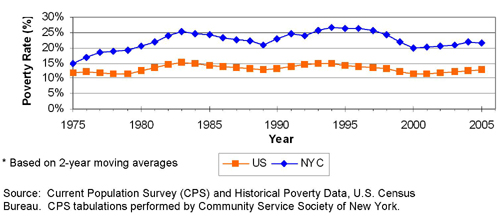
Poverty rates are ever changing in New York, especially from the early 1900’s to todays age.

In December of 1900, Ellis Island opened in the New York Harbor welcoming thousands of immigrants to the city. From 1900 to 1914, “an average of well over half-a-million immigrants came through New York each year”. Many of them “promptly boarded trains for points all across the U.S.“, while thousands of others stayed in the city. As more and more immigrants came to the city, overpopulation became an increasing issue. There were not enough homes and jobs available for the large amounts of immigrants coming through Ellis Island each day. This resulted in poverty and unemployment rates to sky rocket. In an attempt to gain money for their families, many immigrants and born Americans alike, decided to send their children to work for the rich.

Years later in October 1929, the Great Depression struck the United States. Many New Yorkers were left without jobs and impoverished. In an attempt to lower poverty rates, tenement housings were built to house those the without a home. The housings were very dangerous, especially for children.

Now in the 21st century, poverty rates in New York have decreased severely, however there are still many people that live under poverty.
Between 2006-2010 and 2011-2015, over 17% of neighborhoods saw a 10 percentage point increase in their poverty rate. Even though these statistics have decreased drastically from the early 1900’s there is still a lot of work to be done in order to make those numbers smaller.

-K

Info Found:

http://depts.washington.edu/depress/economics_poverty.shtml  

https://allthatsinteresting.com/new-york-immigrants-photos

https://www.nytimes.com/1992/06/10/study-says-poverty-rose-to-25-in-new-york-city.html

http://furmancenter.org/thestoop/entry/focus-on-poverty

Welcome To My Website!

Hello everyone! My name is Kailyn and I am a high schooler from Queens, New York. For a digital activism project assigned by my technology teacher, students were told to choose a topic of their interest to create a blog and several social media sites. I chose to make my project about the large population of people in poverty within the city. All my life I have seen people that live in poverty on the streets and have heard stories from many others about their experiences while in poverty. I want to try my best to help those people, and many others alike, by making an effort to advocate for them.

Thank you for visiting my website and I hope you can join me in helping to support those that live in poverty.

-K

Design a site like this with WordPress.com
Get started